On a recent 7-hour, 35-minute flight from Newark to Milan, we hit moderate turbulence over the Atlantic. It lasted about 30 minutes. It was uncomfortable — but it was expected, briefed, monitored, and handled as a completely normal part of the flight. The aircraft was never close to any speed or structural limits.
Here's what that turbulence looked like from my seat on the flight deck — and why none of it meant the airplane was in danger.
What the Crew Knew Before You Even Boarded
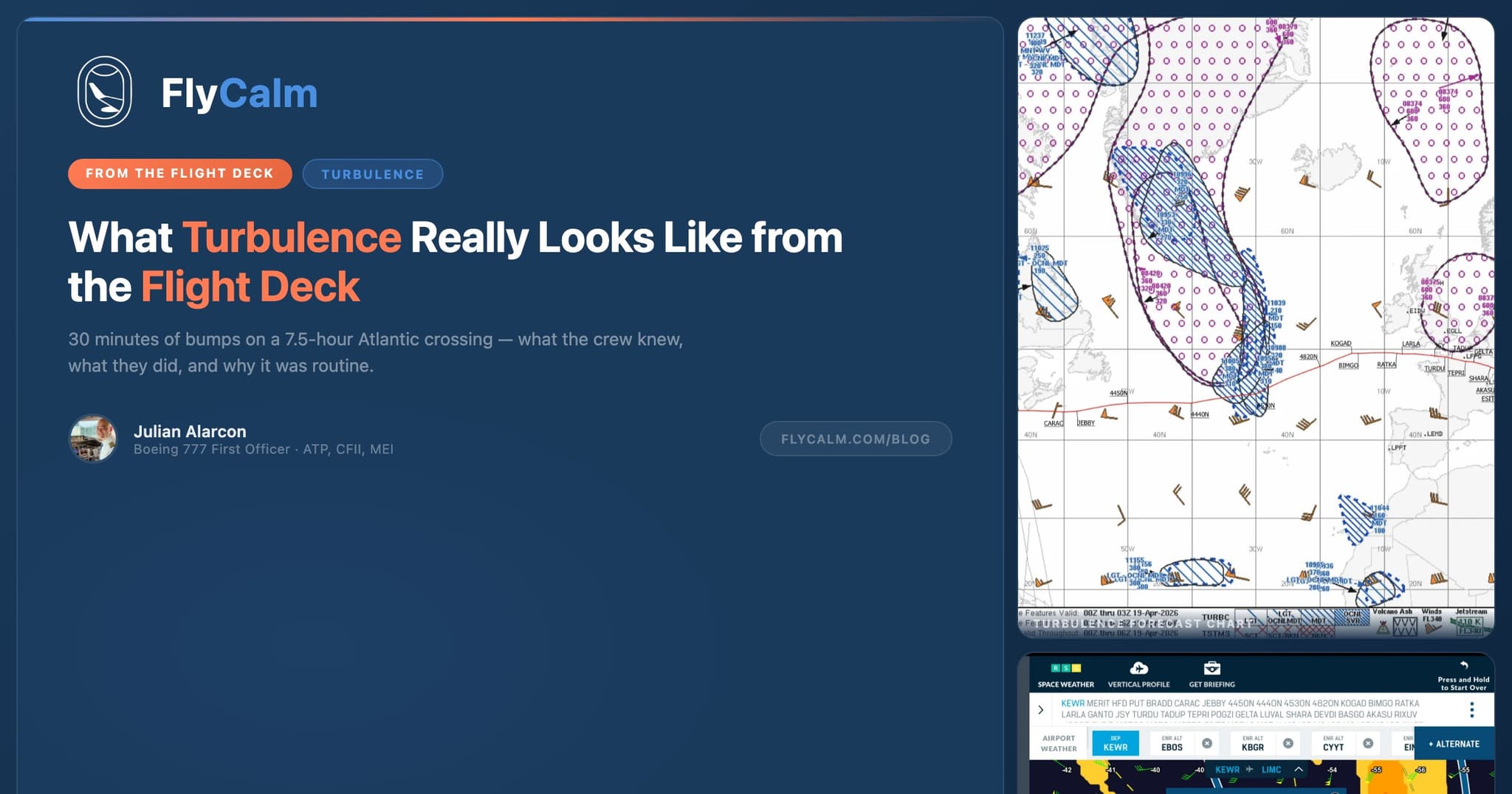
Hours before passengers arrived at the gate, our team had already built us a flight plan designed around the weather. They assigned a south of the . The specific reason? To avoid the worst turbulence forecasted that day.
The forecast showed moderate turbulence near between and FL380, lasting about one hour. We would enter oceanic airspace at FL310 and plan to climb to FL340 as fuel burned off — which meant we would fly through part of the turbulence area. This was expected. Not a surprise.
Before we pushed back from the gate, I briefed the flight attendants: expect moderate turbulence around the halfway point, likely lasting 30 minutes to an hour. They would have time to complete service before it started. When it was time to sit down, we would give them advance notice.
The Flight: Cabin vs. Flight Deck
What follows is the actual timeline of this flight. At each point, I'll show you what passengers likely experienced — and what was actually happening up front. The gap between these two perspectives is where most flight anxiety lives.
Before Passengers Boarded
In the cabin
Passengers boarding, settling into seats, unaware of the route planning and weather briefing that happened in the previous two hours.
On the flight deck
Dispatch assigned a random route south of NAT Tracks to avoid heavier turbulence areas. Crew reviewed weather charts, identified moderate turbulence forecast near 30°W. Flight attendants briefed on expected turbulence timing.
Takeoff and Welcome Aboard
In the cabin
Most passengers are settling in — stowing bags, putting on headphones, choosing a movie. The welcome announcement mentions expected turbulence over the ocean, but it's 3+ hours away and easy to miss.
On the flight deck
Welcome aboard PA includes turbulence advisory. Crew knows most passengers won't register this information yet — it's too far in the future to feel relevant. But the communication has started.
First Signs of Turbulence
In the cabin
Slight bumps begin. The seatbelt sign dings on. Some passengers tense up. Most can still walk comfortably, and drinks only splash occasionally.
On the flight deck
Encountering wave activity. Aircraft speed fluctuating approximately ±15 knots around . Crew slows to Mach 0.83 to increase the buffer above . Seatbelt sign turned on as a precaution — before it gets uncomfortable.
Why the Flight Attendants Sat Down
In the cabin
Bumps getting stronger. Flight attendants stop service and move quickly to their . Engine sounds may change as speed is adjusted. This is often the moment that feels most alarming to anxious passengers.
On the flight deck
Turbulence strengthening as expected. Crew makes announcement to flight attendants: “Take your jumpseats.” This means: secure yourselves within the next few minutes. It is a standard precaution — not an emergency command. We also attempted a climb to FL340, but the aircraft was still too heavy to go higher efficiently.
Moderate Chop at 31,000 Feet
In the cabin
Definite bumps. Drinks splashing. You feel strain against your seatbelt. Walking would be difficult. This is the uncomfortable part — and for many anxious flyers, the scariest.
On the flight deck
Moderate with very little speed variation. The crew expects this to last about 30 minutes based on the forecast. PA announcement made to passengers: describes the turbulence, gives a time estimate, asks everyone to remain seated.
Inside the Forecast Turbulence Zone
In the cabin
Sustained bumps. Engine noise changing as speed is managed. You might feel slight altitude shifts. Another PA announcement asks passengers and crew to remain seated.
On the flight deck
Now in the heart of the forecast turbulence zone. Continuous moderate turbulence — matching expectations exactly. Aircraft speed never close to any limits: approximately 25 knots of margin before overspeed, and 36 knots before the aircraft would be too slow. The aircraft is riding the air — fully within its envelope.
Clear Air Again
In the cabin
Bumps fading. The ride smooths out noticeably. Flight attendants begin moving again. Service resumes. The relief is palpable.
On the flight deck
Exiting the turbulence area as forecast. Ride smoothing rapidly. Seatbelt sign remains on briefly while the crew confirms conditions have improved and are stable. Then the sign is turned off, and the flight continues normally to Milan.
Landing in Milan
In the cabin
Normal arrival. Passengers deplane. Many probably forgot about the bumps entirely.
On the flight deck
A routine flight with a bumpy stretch in the middle. No damage. No injuries. No writeup. We signed the logbook and headed to the hotel.
What Does Moderate Turbulence Actually Feel Like?
Turbulence has an official scale that pilots use to report conditions. Understanding where “moderate” sits on this scale can help put the experience in perspective. This flight's turbulence was moderate — solidly in the middle, not at the top.
Turbulence Intensity Scale
Light → ExtremeSlight bumps. Drinks may splash occasionally. You can walk normally. You might feel a light tug on your seatbelt.
Slight erratic changes in altitude/attitude. Little difficulty walking.
Quick, rhythmic bumps — like driving on a rough road. No big movements.
Rapid bumpiness without altitude/attitude changes.
Uncomfortable. Drinks spill consistently. Walking is difficult. You feel definite pressure against your seatbelt. But the aircraft is fully in control.
Changes in altitude/attitude, aircraft remains in positive control. Variations in airspeed.
Rapid jolts, but the plane isn't climbing or descending. Like a faster, harder washboard road.
Rapid bumps without appreciable altitude/attitude changes.
Rare. Unsecured items move. Walking is impossible. You're pressed hard into your seatbelt. The aircraft may momentarily feel out of control, but it recovers.
Large abrupt changes, aircraft may be momentarily out of control. Large airspeed variations.
Essentially never encountered by commercial flights. Aircraft practically impossible to control.
Violent tossing, practically impossible to control. May cause structural damage.
This flight experienced moderate turbulence — solidly in the middle of the scale. Severe is extremely rare in commercial aviation. Extreme essentially never happens.
Severe turbulence is extremely rare in commercial aviation — most pilots encounter it only a handful of times in an entire career. Extreme turbulence essentially never happens to commercial flights. The turbulence on this flight was uncomfortable, yes. But it was well within the range that aircraft are designed for and that crews manage routinely.
The Pilot's Dilemma: When to Make an Announcement
During the turbulence, my colleague and I had a conversation that I think reveals something about how crews think about passengers:
We know that passengers with a fear of flying benefit from PA announcements — hearing from the flight deck that everything is okay can make a real difference. But at what point do we wake up passengers who are sleeping? Interrupt the movie someone is finally relaxing into? On an international flight, announcements are made in English and then the local language, so each one takes time. It's a real balance we think about.
I share this because it shows something important: the situation in the flight deck was calm enough that the two pilots were having a thoughtful conversation about passenger comfort — not fighting for control of the aircraft. That's what moderate turbulence actually looks like from up front. It's work, but it's manageable, expected work.
The Math: 30 Minutes Out of 7.5 Hours
When you're in turbulence, it can feel like it lasts forever. Your sense of time compresses. Every bump registers. But here are the actual numbers:
If you were watching a 2-hour movie during that turbulence, the bumps would have lasted for about 8 minutes of screen time. The rest of the film would have been smooth. Most transatlantic flights have even less turbulence than this one — this was a flight where moderate turbulence was specifically forecast, and it still only affected a small fraction of the journey.
What to Remember on Your Next Flight
- Keep your seatbelt fastened whenever seated — even when the sign is off. This is the single most effective thing you can do for your safety during unexpected bumps.
- The seatbelt sign is a precaution, not an alarm. It often comes on well before turbulence starts, because the crew is being proactive.
- Flight attendants sitting down is standard procedure. It means the crew is being careful with their team — not that something is wrong with the aircraft.
- Engine noise changes are normal. Pilots adjust speed during turbulence to maintain safe margins. The sound change is the crew doing their job.
- PA announcements during turbulence are for your safety. They are asking you to stay seated — not warning of danger.
- Discomfort is not the same as danger. Moderate turbulence is uncomfortable, but the aircraft is engineered to handle forces far beyond anything you will ever experience in flight.
- The crew probably knew about the turbulence before you boarded. It was briefed, planned for, and monitored the entire time.
- On this 7.5-hour flight, turbulence lasted 30 minutes. That's less than 7% of the flight. The rest was smooth.
Want to understand your next flight?
If turbulence anxiety affects your travel, our pilot-led sessions can help you understand what's happening and why it's safe. Talk directly with the pilots who fly these routes.
Book a Session with a Pilot